
I used to go to Rio for Carnival. Then I moved our trip to August, on purpose, to give Rio more room. The city doesn't need a parade to show off. It has Little Africa, samba, the colorful steps and the beach, and in August you get all of it with space to breathe.
This is everything I'd tell you before your first trip: what to do, when to go, where to stay and exactly how our seven days run.
Key facts
- Our trip: the seven-day Brazil Experience, August 6 to 12, 2027 and August 4 to 10, 2028, six nights at the Fairmont Rio de Janeiro Copacabana.
- Rio in August: winter, which in Rio means mild and dry. Highs around 78°F (26°C), lows around 65°F (18°C), and one of the driest months of the year.
- Getting there: fly into Rio de Janeiro/Galeão International Airport (GIG).
- Entry: U.S. citizens need a visa for Brazil, applied for online as an e-visa (as of October 2026).
- The locals: people from Rio are called cariocas.
Best Things to Do in Rio de Janeiro
The best things to do in Rio de Janeiro are Christ the Redeemer on Corcovado, Sugarloaf Mountain at sunset, the Selarón Steps (Escadaria Selarón), the African history of Little Africa, a long beach day the way cariocas do it, brunch at the Copacabana Palace, the Botanical Garden and the street art at Praça Mauá.
- Christ the Redeemer. The statue stands with open arms on top of Corcovado, about 2,300 feet above sea level, and it's one of the New Seven Wonders of the World. On our trip, it's Day 5.
- Sugarloaf Mountain at sunset. Two cable cars take you up, first to Urca Hill and then to the summit, and the whole city turns gold below you. It's Day 3 on our trip.
- The Selarón Steps. A staircase of 215 steps between Lapa and Santa Teresa, covered in tiles from all over the world. We're there on the morning of Day 3.
- Little Africa. Pedra do Sal, where samba took root, and Valongo Wharf, the UNESCO World Heritage site where enslaved Africans were forced ashore. Give it a full morning. It's Day 4 on our trip.
- A beach day the way locals do it. Skip the postcard stretch for a day and go where the cariocas go: a chair, an umbrella, grilled cheese on a stick from a passing vendor, and a samba circle that starts out of nowhere. That's Day 2 for us.
- Brunch at the Copacabana Palace. The grand hotel on Copacabana Beach has been open since 1923, and our brunch there comes with unlimited bubbles on Day 3.
- The Botanical Garden. Founded in 1808, with towering palms, orchids and the kind of quiet a big city rarely gives you. It's on Day 5.
- The street art at Praça Mauá. The port's waterfront is home to Eduardo Kobra's "Etnias," a mural covering about 3,000 square meters (some 32,000 square feet) painted for the 2016 Olympics, which Guinness World Records recognized that year as the largest graffiti mural in the world. We see it on Day 4.
Before you pack, read what to wear in Rio de Janeiro in August.
Christ the Redeemer

You've seen the photo a thousand times. It still gets you in person.
Christ the Redeemer stands on the peak of Corcovado, a mountain about 2,300 feet (700 meters) high inside Tijuca National Park. The statue itself is ninety-eight feet (thirty meters) tall, on a pedestal of about twenty-six feet (eight meters). Designed by the Brazilian engineer Heitor da Silva Costa and sculpted by the French sculptor Paul Landowski, it was completed in 1931 and dedicated on October 12, 1931. In 2007 it was named one of the New Seven Wonders of the World.
Most people go up by the cog train that climbs through the forest, or by the road to the top. On our trip, Day 5 starts with a Christ the Redeemer tour, then lunch at a Michelin Guide steakhouse, then the Botanical Garden.
My advice:
- Go early. Clouds can roll over the peak, and the morning crowd is thinner.
- Look both ways. The statue faces the city, but the views run from Sugarloaf to the lagoon to the ocean.
- Remember it's a sanctuary. People come to pray here too, so keep it respectful.
Sugarloaf Mountain at Sunset

If you only catch one sunset in Rio, make it this one.
Sugarloaf (Pão de Açúcar) rises 1,299 feet (396 meters) at the mouth of Guanabara Bay. The cable car runs in two stages: the first goes from Praia Vermelha to Urca Hill, at 722 feet (220 meters), and the second carries you to the summit. The first stage opened in 1912, which made it only the third cableway ever built in the world.
On our trip, Sugarloaf caps Day 3, after the steps and the brunch, so you go up as the light turns.
My advice:
- Get up there before the sun drops, so you're settled when the sky starts to change.
- Bring a light layer. August evenings at the top can feel cool.
- Stay after sunset. The city lights come on below you, and that's the second show.
Selaron Steps in Rio de Janeiro
 Photo: Caviar in the Air
The colorful steps. I could look at them all day.
Locals write it Escadaria Selarón; most visitors just say the Selaron Steps in Rio de Janeiro. In 1990 the Chilean-born artist Jorge Selarón started fixing up the rundown steps outside his house, first in blue, green and yellow tiles, the colors of the Brazilian flag. He didn't stop. He worked on the staircase until his death in 2013 and called it his tribute to the Brazilian people.
Today the 215 steps link the Lapa and Santa Teresa neighborhoods, covered in more than two thousand tiles from more than sixty countries, many of them sent by visitors. You may also know them from Snoop Dogg and Pharrell's "Beautiful" video in 2003.
On our trip, the steps are the morning of Day 3, before brunch at the Copacabana Palace and sunset on Sugarloaf. The night before, Day 2, ends with dinner at a hillside restaurant in Santa Teresa, just up the hill.
My advice:
- Go early, before the crowds build.
- Take turns. Everyone wants the shot, so share the stairs and you'll all get it.
- Wear shoes with grip. The tiles are uneven and some are slick.
Little Africa in Rio de Janeiro
This is the part of Rio I want you to see.
Pequena África, or Little Africa, is the name for the old port neighborhoods of Saúde, Gamboa and Santo Cristo. After abolition in 1888, freed Africans, Afro-Brazilian families and workers who came from Bahia made their lives here. The music they played in these streets grew into samba.
- Valongo Wharf (Cais do Valongo). Built starting in 1811 to land enslaved Africans arriving in Brazil, it was later paved over and forgotten, then uncovered in 2011 during work on the port. UNESCO estimates that as many as nine hundred thousand Africans arrived in South America through Valongo, and in 2017 it named the site a World Heritage site, the most important physical trace of the arrival of enslaved Africans in the Americas. Stand there for a minute. It asks that of you.
- Pedra do Sal. The rock at the foot of Conceição Hill where samba took root, widely called the birthplace of samba. People still gather there to play.
- Instituto Pretos Novos. In 1996, a family renovating their house in Gamboa found human remains beneath the floor: a burial ground for enslaved Africans who died soon after the crossing. The house is now a memorial and research institute.
- Praça Mauá. The street art tour includes Kobra's "Etnias" mural, faces of peoples from five continents.
On our trip, Day 4 is Little Africa with a local guide, the street art at Praça Mauá, and then an afternoon Brazilian cooking class with unlimited caipirinhas, where you learn moqueca, tapioca and brigadeiro.
If Little Africa moves you, Bahia is the next place to go. Read my guide to Bahia and Afro-Brazilian culture.
Rio de Janeiro Travel Itinerary, Day by Day
Here's our Rio de Janeiro travel itinerary, exactly as the Brazil Experience runs it: six nights at the Fairmont Rio de Janeiro Copacabana, with an on-site Tour Leader the whole way.
Day 1: Bem-Vindos
Land at Rio de Janeiro/Galeão International Airport (GIG) before 3 PM, where your meet and greet is waiting. Transfer to the Fairmont Rio de Janeiro Copacabana and check in.
Evening: the welcome dinner at the hotel's oceanfront restaurant, with Copacabana Beach as your backdrop. You order what you like and bill it to your room, with a room credit toward it.
Day 2: The Beach and Carnival Secrets
Day: a traditional Brazilian beach day where the locals go, with music, caipirinhas from the beach vendors (on your own) and samba circles. Lunch at the beach is on your own. Then a behind-the-scenes Carnival tour, for the preparations most visitors never see.
Evening: dinner at a Michelin-recommended hillside restaurant in Santa Teresa, with some of the best views of the city.
Day 3: The Steps, Brunch and Sugarloaf
Morning: the Selarón Steps.
Midday: brunch at the Copacabana Palace with unlimited bubbles.
Evening: the Sugarloaf Mountain sunset experience. Dinner is on your own.
Day 4: Little Africa and a Cooking Class
Morning: a Little Africa cultural walking tour: Pedra do Sal, Valongo Wharf and Instituto Pretos Novos, then the street art tour at Praça Mauá.
Afternoon: a hands-on Brazilian cooking class with unlimited caipirinhas, where you make moqueca, tapioca and brigadeiro and eat what you cook. Dinner is on your own.
Day 5: Christ the Redeemer and the Botanical Garden
Morning: the Christ the Redeemer tour.
Afternoon: lunch at a Michelin Guide steakhouse, then the Botanical Garden. Dinner is on your own.
Day 6: The All-White Yacht Party
Day: put on your all-white look and board our private yacht from 10 AM to 2 PM. We sail Rio's coast with stops to swim, and the skyline, Sugarloaf and Christ the Redeemer are your backdrop. Lunch and dinner are on your own.
Day 7: Até Logo, Rio
Morning: one last breakfast at the Fairmont, then your private transfer to GIG. Book a flight that leaves after 8 AM.
What's Included
- Six nights at the Fairmont Rio de Janeiro Copacabana, with daily breakfast
- The welcome dinner at the hotel's oceanfront restaurant, with a room credit toward it
- A traditional Brazilian beach day where the locals go
- A behind-the-scenes Carnival tour
- Dinner at a Michelin-recommended hillside restaurant
- A visit to the Selarón Steps
- Brunch at the Copacabana Palace with unlimited bubbles
- The Sugarloaf Mountain sunset experience
- A Little Africa cultural walking tour
- A street art tour at Praça Mauá
- A Brazilian cooking class with unlimited caipirinhas
- A Christ the Redeemer tour
- Lunch at a Michelin Guide steakhouse
- A Botanical Garden visit
- The farewell yacht party (all-white dress code)
- All airport transfers and ground transportation
- An on-site Tour Leader throughout, and concierge support before and during the trip
Not included: round-trip international flights to and from Rio de Janeiro (GIG), though we can help you book; travel insurance, which we strongly recommend; personal expenses such as shopping and souvenirs; meals on your own (lunch on Days 2 and 6, and dinner on Days 3, 4, 5 and 6); and gratuities for guides, drivers and service staff.
When to Go to Rio de Janeiro

Rio is in the Southern Hemisphere, so the seasons flip. Summer, roughly December to March, is hot, humid and the rainiest stretch of the year, and Carnival falls in February or early March.
Our trip is in August, Rio's winter. Don't let the word fool you. August highs average around 78°F (26°C), lows around 65°F (18°C), and it's one of the driest months of the year, with rain on only a handful of days. The ocean sits around 72°F (22°C), which is refreshing. Every so often a cold front pushes in and the nights drop lower, so pack a layer.
I used to plan my Rio trips around Carnival. It's a party, and it's crowded. Moving our trip to August gave Rio more room: the beach, the steps, Little Africa and the samba, without the crush. You still get a taste of Carnival on Day 2, behind the scenes.
For more on the country beyond Rio, read Brazil beyond Carnival.
Where to Stay in Rio de Janeiro

For a first trip, stay on the beach in the South Zone. Copacabana puts you on the sand and close to everything. Ipanema and Leblon, a little farther along the coast, are quieter and polished. Santa Teresa, up in the hills, is artsy and charming, but you'll lean on cars to get around.
Our hotel: the Fairmont Rio de Janeiro Copacabana. It sits at the Posto 6 end of Copacabana Beach, opened as a Fairmont in 2019, and its pool deck looks straight across the water to Sugarloaf. Our rooms are a Fairmont Room with one king bed and a city view, and breakfast is included every morning. You unpack once for six nights.
The classic: the Copacabana Palace. Open since 1923 and still the grand dame of the beach. We go for brunch on Day 3.
Rio de Janeiro Travel Tips
- Entry for U.S. citizens: as of October 2026, U.S. citizens need a visa to visit Brazil. Brazil reinstated the requirement on April 10, 2025, and for tourism stays of up to ninety days you apply online for an e-visa through the Brazilian government's authorized portal. Apply well before you fly, and bring a passport valid for your whole trip with blank pages for the entry and exit stamps. Rules change, so check again before you travel.
- Currency: the Brazilian real (R$, BRL). Cards are widely accepted in Rio. Keep a little cash in reais for the beach vendors.
- Safety basics: the U.S. State Department rates Brazil Level 2, "exercise increased caution." Keep your phone out of sight on the street and the beach, leave the good jewelry in the safe, carry only what you need, and use the cars we arrange instead of wandering into neighborhoods you don't know at night.
- Plugs: Brazil uses Type N outlets (three round pins), and some older buildings still have Type C (two round pins). U.S. plugs don't fit, so bring an adapter. Rio runs on 127 volts, but check your hair tools before you plug them in.
- Carioca: a carioca is someone from Rio. You'll hear it all the time, and by Day 2 you'll be living like one.
- Language: Brazilians speak Portuguese, not Spanish. Learn "obrigada" (thank you, if you're a woman) and use it often.
- What to wear: August is mild, so think beach looks by day, a layer for the evening, and one all-white outfit for the yacht. Here's what to wear in Rio de Janeiro in August, with a packing list.
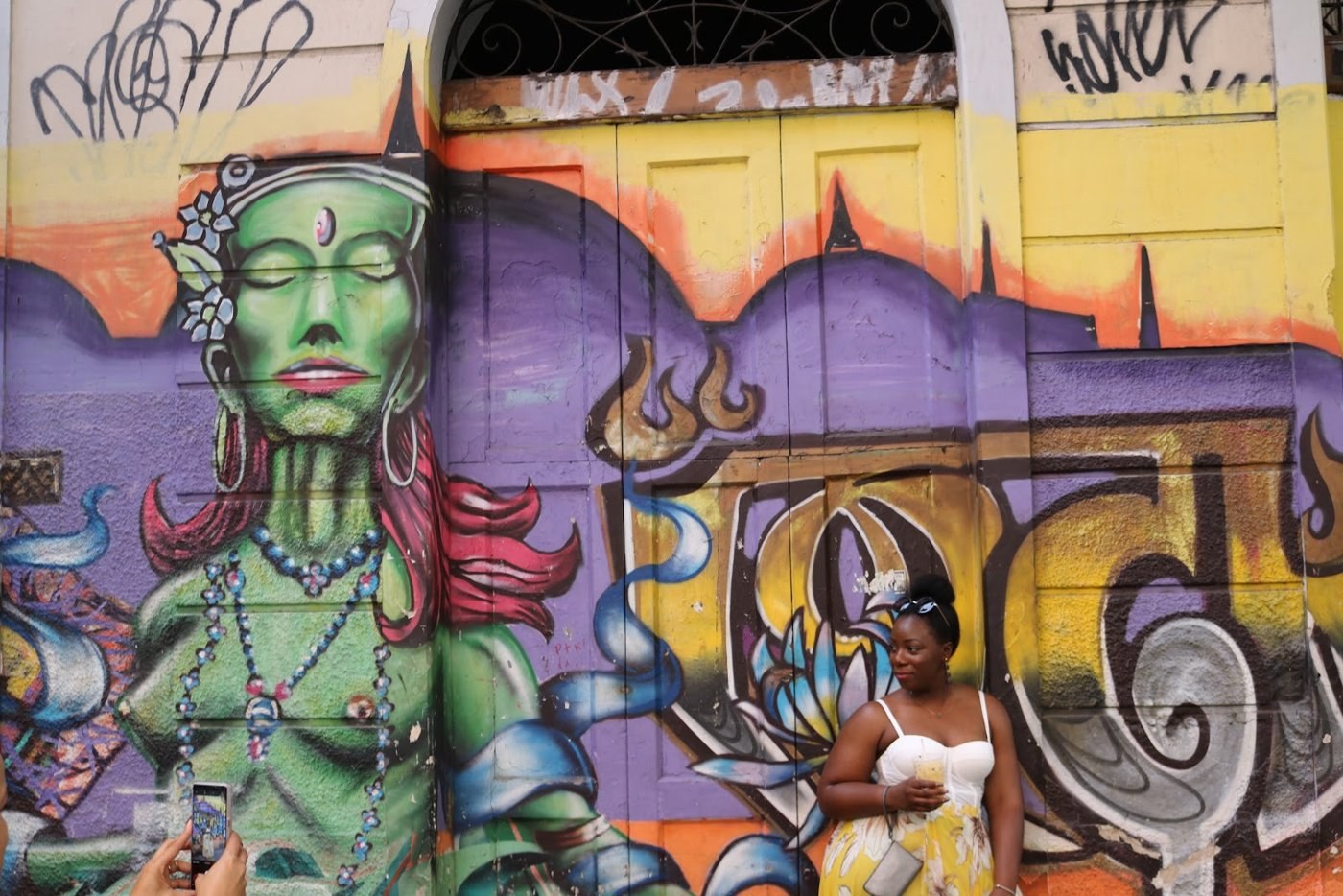 Photo: Caviar in the Air
Rio's walls are part of the show. Wear white, bring a friend with a good eye, and hold still for one second.
Come to Rio With Us
Our Brazil Experience runs August 6 to 12, 2027 and August 4 to 10, 2028: six nights at the Fairmont Rio de Janeiro Copacabana, Christ the Redeemer, Sugarloaf at sunset, the Selarón Steps, Little Africa, a beach day like a carioca, brunch at the Copacabana Palace and an all-white yacht party, all taken care of for you. You just show up in Rio. I got you.
Claire B. Soares is the founder of Caviar in the Air.

 Destination Guide
 Destination Guide
 Destination Guide